Signed in as:
filler@godaddy.com
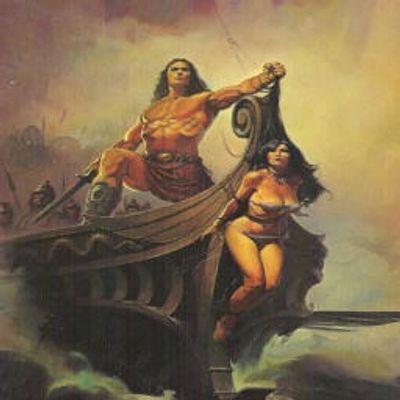
"Ho!" cried Torm, that most improbable member of the Caste of Scribes, throwing his blue robes over his head as though he could not bear to see the light of day.
I sensed that a certain distrust existed between the Caste of Scribes and the Caste of Initiates.
I was specially drilled in the Code of the Warrior Caste.
"It's just as well," said Torm. "You would never make a Scribe."
. . .
I was also instructed in the Double Knowledge - that is, I was instructed in what the people, on the whole, believed, and then I was instructed in what the intellectuals were expected to know. Sometimes there was a surprising discrepancy between the two. For example, the population as a whole, the castes below the High Castes, were encouraged to believe that their world was a broad, flat disk. Perhaps this was to discourage them from exploration or to develop in them a habit of relying on commonsense prejudices something of a social control device.
On the other hand, the High Castes, specifically the Warriors, Builders, Scribes, Initiates, and Physicians, were told the truth in such matters, perhaps because it was thought they would eventually determine it for themselves, from observations such as the shadow of their planet on one or another of Gor's three small moons during eclipses, the phenomenon of sighting the tops of distant objects first, and the fact that certain stars could not be seen from certain geographical positions; if the planet had been flat, precisely the same set of stars would have been observable from every position on its surface.
I wondered, however, if the Second Knowledge, that of the intellectuals, might not be as carefully tailored to preclude inquiry on their level as the First Knowledge apparently was to preclude inquiry on the level of the Lower Castes. I would guess that there is a Third Knowledge, that reserved to the Priest-Kings.
The Scribes, of course, are the scholars and clerks of Gor, and there are divisions and rankings within the group, from simple copiers to the savants of the city.
"Hemartius, I have learned," said Ruffio, "is now the chief scribe of the law in the court of the Ubar."
These two men were accompanied by some scribes of the law and clerks of the court.
"Now," said Hemartius, gesturing toward the Scribes' table, "the signings, and stampings, the affixing of the state seals, and all is done."
"You are certain that this is all legal?" I said.
"Certainly," he said. "Somewhat unusual or eccentric, perhaps, but all legal."
Decius Albus signed the document for Ar, in a large, vigorous, sharply angled script. I almost feared he might thrust the scratching pen through the rence paper. I hoped that that would not void the document. I then signed where I was told to sign, and the two scribes stamped the document, and affixed seals, and then, as witnesses, added their own signatures in a small, neat hand.
"It is done, noble client," said Hemartius.
"I may need a scribe, a scribe of the law," I said. "You are the only one I know in Ar."
As I left the chamber, I passed the shorter of the two scribes, he of the darker blue robes, that suggesting a certain priority in his caste.
a dangling blue scroll, or a dangling tablet with a stylus or pen, commonly stands for a scribe,
Demetrion's aides were as reluctant as he to stoop to retrieve the small, but weighty sack. The two Scribes, as well, looked away. Little love is lost between the Scribes and Merchants. The Scribes is a high caste and the Merchants is the richest caste. Each therefore regards itself as superior to the other, and each, then, would be reluctant to seem to lower itself before the other. I would have been quite willing to retrieve the sack and deliver it to Demetrion, but Phillip, my superior, was in his party, and there is, of course, the dignity, and the prestige, of the caste to maintain.
Even a brilliant woman, witty and articulate, learned, of the high Scribes, collared, her blue robes exchanged for a rag, must apply herself to new studies, the use of her lips and tongue, of her small fingers and glossy hair.
Assassin of Gor, Book 5, Page 208


Needless to say, caste members do not always wear the caste colors. For example, a scribe would normally wear his blue when working but not always when at leisure.
This hairdo here, on Crystal, with the bun in the back, is favored by many free women of the scribes.
"Were you truly of the scribes?" asked the man.
"Yes," said Inge, startled.
"The refinement of your accent," he said, "suggested the scribes."
"Thank you, Master," said Inge, lowering her head.

"What is your name?" I asked the girl.
"A slave has no name," she said. "You may give me one if you wish."
In the eyes of Goreans, and Gorean law, the slave is an animal. She is not a person, but an animal. She has no name, saving what her master might choose to call her. She is without caste. She is without citizenship. She is simply an object, to be bartered, or bought or sold. She is simply an article of property, completely, nothing more.
"I will give you a new name." She nodded, miserably. Her old name, her old identity, had been taken from her forever. Her new name, though in sound the same, was not her old. Between them there was a difference of worlds, a gulf wider than the dividing planets. Her old name had been hers as a free person, publicly registered, legally certified, historically identified with her throughout her life, until her capture by slavers. It had been a proud, intimate possession, giving her pleasure and dignity. It had ennobled her. It has served, with other properties, to distinguish her as a precious person, a unique individual, among all others on the planet Earth. When asked who she was, it was with that name that she would answer. That was who she was. Then that name was taken from her. She was only an animal in bondage. Her name might be changed, or altered, as often as a Master wished. Indeed, he need not even give her a name. Changing a girl's name, or taking it away, are common modes of Gorean slave discipline."
"A girl in a collar is not permitted inhibitions," she said. It was true. Slave girls must reveal their sexual nature, totally. Do they not do so, they are beaten."